Can you become allergic to coconut as an adult?
Yes, and it's common: nearly half of food-allergic adults developed an allergy after childhood. Why coconut is easy to miss, why it can look like sinus trouble instead of hives, and what to ask for.
Published September 26, 2026 · 4 min read
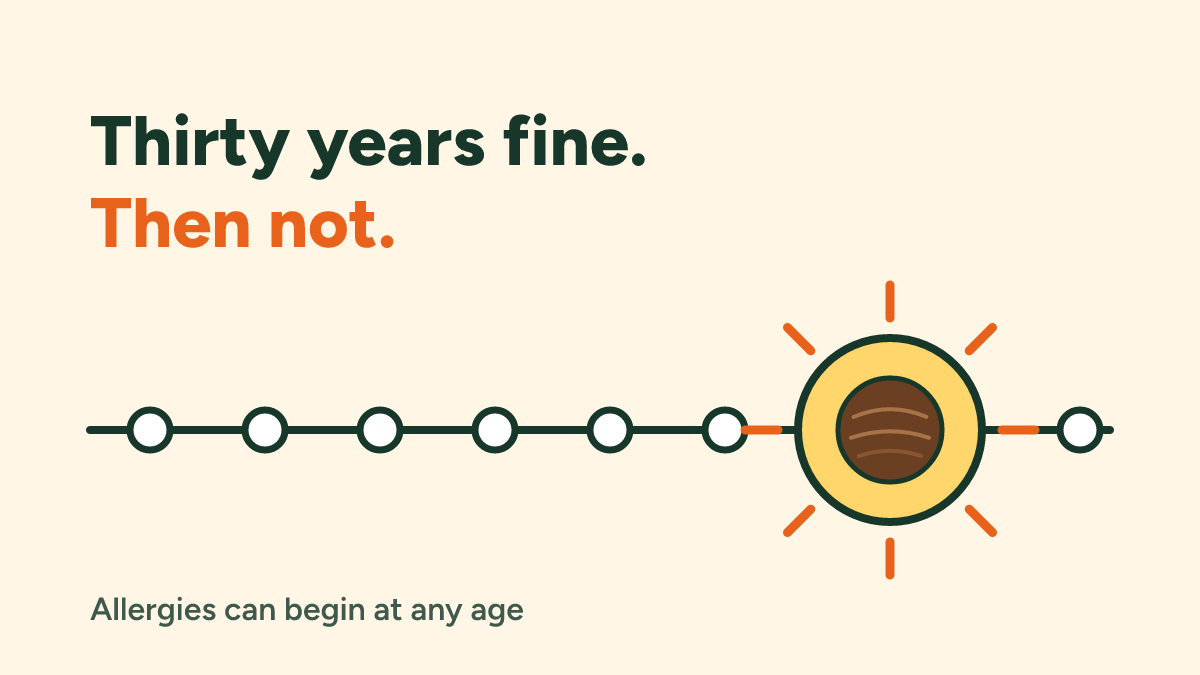
You ate coconut for thirty years. You washed your hair with it without knowing. Then something changed, and now you're reading an ingredient list in a pharmacy aisle wondering whether you've lost your mind.
You haven't. This happens, and it happens to a lot of people.
Adults develop new food allergies all the time
In a survey of more than 40,000 US adults, published in JAMA Network Open, 48% of food-allergic adults said at least one of their allergies began in adulthood [1]. Not childhood allergies carried forward. New ones.
That study also found more than 10% of US adults have a food allergy, roughly 26 million people [1]. Adult onset isn't a curiosity. It's half the picture.
Nobody can tell you exactly why it happens to one person and not another. What matters is that "I've eaten this my whole life" is not evidence that you aren't allergic now.
Why coconut takes longer to spot than most
A peanut allergy usually announces itself: one food, one reaction, an obvious link. Coconut is harder for three reasons.
It isn't only food. Coconut is in shampoo, soap, body wash, hand wash, toothpaste, lip balm, makeup, cream, sunscreen. Most of your exposure isn't at the table, it's in the bathroom, twice a day, every day. Where coconut hides is the tour.
It rarely says "coconut". It says cocamidopropyl betaine, sodium cocoyl isethionate, caprylic/capric triglyceride, cocoglycerides. You can read a whole label, see no coconut, and still be washing in it. That's what Coconut's many names is for.
Daily exposure doesn't look like a reaction. One big dramatic response is easy to connect to a cause. A small one, every single day, from three products you never suspected, doesn't look like an allergy at all. It looks like you: like a face that's always a bit irritated, a nose that's always a bit blocked, skin that's always a bit angry.
It doesn't always look like hives
Most people picture an allergy as swelling, hives, an emergency. Those happen, and what a reaction looks like covers them, including when to call for help.
But cosmetics can also cause contact allergy: a slower, duller reaction in the skin that shows up hours later as redness, itching, dryness or a rash, often where the product sat. Two coconut-derived ingredients are well known for it. Cocamidopropyl betaine, the foaming agent in a huge share of shampoos and washes, was named Allergen of the Year by the American Contact Dermatitis Society in 2004, and alkyl glucosides, the "gentle natural" surfactants, took the same title in 2017 [2].
That second one is worth sitting with: the ingredients marketed as the mild, natural alternative are among the most recognised contact allergens in cosmetics.
If you suspect something, do this first
Write down everything that touches you daily for a week: shampoo, conditioner, soap, toothpaste, lip balm, face cream, deodorant, makeup, hand wash. Then check each label, or photograph them one at a time. A list beats a memory, and your allergist can work with a list.
What to ask for
Take the list to a doctor and ask for a proper assessment. Depending on what you describe, that can mean:
- Skin prick testing or specific IgE blood tests for immediate, food-type allergy.
- Patch testing for contact allergy, which is a different test, done by a dermatologist, and the only one that finds reactions to things like cocamidopropyl betaine. If your problem is your skin and your products, ask about this one by name.
Say out loud that you want cosmetics considered, not only food. It's the part that gets skipped.
And if you've already been tested: read the results again. People are handed a sheet with a long list, focus on the one line the doctor circled, and never look at the rest.
Why this takes so long to work out
Because nothing about it is obvious. The reaction is spread across a dozen products, most of them don't say coconut, the symptoms don't look like the textbook, and the cause is in your bathroom, not on your plate.
It took us three years, one unnecessary sinus surgery and a re-read of an old test result. That story is here, and the reason this site exists is so it takes you less time than it took us.
Sources
- Gupta RS, Warren CM, Smith BM, et al. "Prevalence and Severity of Food Allergies Among US Adults." JAMA Network Open, 2019. jamanetwork.com
- American Contact Dermatitis Society, Allergens of the Year 2000 to 2020, Dermatologic Clinics, 2020 (cocamidopropyl betaine, 2004; alkyl glucosides, 2017). derm.theclinics.com
Educational only, not medical advice. Always confirm with your allergist.