Where coconut hides
Coconut rarely says “coconut” on a label. It hides in soap, shampoo, creams and foods under chemical names. Here are the most common ones and why the label can’t always tell you.
Published September 19, 2026 · 3 min read
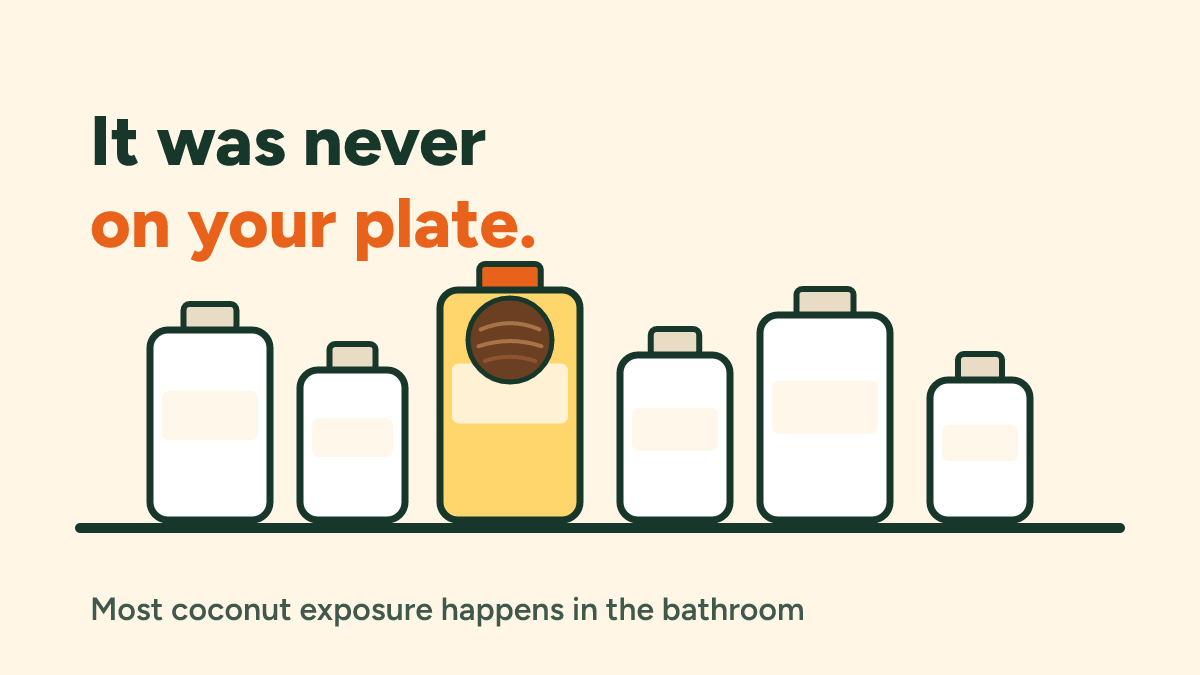
On food, coconut is usually easy to spot: coconut oil, milk, flakes, sugar. On cosmetics it’s a different story. Soap, shampoo, body wash, creams and makeup often contain ingredients made from coconut oil whose names don’t say so.
Made from coconut
These ingredients are coconut-derived by name or by how they’re made:
| On the label | Where you’ll find it | Why it’s coconut |
|---|---|---|
| Sodium cocoate | bar soap | the salt of fatty acids from coconut oil: this is “coconut soap” [1] |
| Cocamidopropyl betaine | shampoo, body wash, baby wash | made starting from coconut fatty acids [2] |
| Cocamide DEA | hand soap, dish soap | a derivative of coconut oil [3] |
| Coco-glucoside | “natural” and baby cleansers | made from coconut alcohol and glucose [4] |
| Caprylic/capric triglyceride | creams, sunscreen, makeup | traditionally made by splitting coconut oil [5] |
Anything starting with coco- or cocam- is a good clue. The full list, in English and Spanish, is on the coconut’s names page.
Coconut or something else: you can’t tell
Some very common ingredients can be made from coconut or from other oils, and the label doesn’t say which. On this site they get an amber flag:
- Glycerin: made from many different fats and oils, or synthetically, and labelled “glycerin” either way [6].
- Sodium lauryl sulfate (SLS) and sodium laureth sulfate (SLES): made from lauryl alcohol, which can come from coconut oil or from petrochemicals [7].
- Decyl and lauryl glucoside: their fatty alcohols can come from coconut oil or palm oil [4].
- MCT oil (medium-chain triglycerides): found in coconut oil, palm kernel oil and milk fat, or made synthetically [8].
When it matters, the only way to know is to ask the maker. That’s why we write to brands and publish their answers.
Why the label doesn’t tell you
Cosmetic labels must use standard ingredient names (called INCI names in the EU), not the plant they came from [9]. So “glycerin” from coconut and “glycerin” from palm look exactly the same.
Food, formula and medicines
- Infant formula: coconut oil is a known fat source in some formulas, and there is at least one published case of an infant reacting to coconut oil in formula [10].
- Medicines: we haven’t found reliable reports of reactions to coconut in medicines. If you’re worried about a specific medicine, ask your pharmacist about its inactive ingredients.
Two places people forget
Medicines carry inactive ingredients too, and some are coconut-derived: see coconut in medicines. Fragrance is its own puzzle, because the bottle often has no list at all: see perfume, body mist, roll-on.
Sources
- Cosmetic Ingredient Review. “Amended Safety Assessment of Cocos Nucifera (Coconut) Oil…”, 2008. PDF
- Knopp E., Watsky K. “Eyelid Dermatitis: Contact Allergy to 3-(Dimethylamino)propylamine.” Dermatitis, 2008. PMC
- Aalto-Korte K., Pesonen M. et al. “Occupational allergic contact dermatitis caused by coconut fatty acids diethanolamide.” Contact Dermatitis, 2014. PubMed
- Cosmetic Ingredient Review. “Final Safety Assessment: Decyl Glucoside and Other Alkyl Glucosides”, 2011. PDF
- Cosmetic Ingredient Review. “Final Report of the Safety Assessment for Caprylic/Capric Triglyceride”, 1980. PDF
- NIH PubChem. “Glycerol.” pubchem.ncbi.nlm.nih.gov
- NIH PubChem. “1-Dodecanol” and “Sodium laureth sulfate.” 1-Dodecanol · SLES
- Jadhav H.B., Annapure U.S. “Triglycerides of medium-chain fatty acids: a concise review.” Journal of Food Science and Technology, 2023. PubMed
- Regulation (EC) No 1223/2009 on cosmetic products, Article 19. EUR-Lex · US 21 CFR 701.3. eCFR
- Couturier P. et al. “A case of coconut oil allergy in an infant: responsibility of ‘maternalized’ infant formulas.” Allergie et Immunologie, 1994. PubMed · Furse S., Koulman A. “The Lipid and Glyceride Profiles of Infant Formula Differ by Manufacturer, Region and Date Sold.” Nutrients, 2019. PubMed
Educational only, not medical advice. Always confirm with your allergist.