Coconut in medicines: the ingredients nobody reads
Creams, gels and capsules carry inactive ingredients too, and some are coconut-derived. How to check a medicine, what to ask the pharmacist, and why you should never stop a treatment on your own.
Published September 25, 2026 · 3 min read
Never stop a medicine you need because of this page.
If something you take worries you, keep taking it and ask your doctor or pharmacist for an alternative. A flare of pain, asthma or infection is a certain harm; a trace excipient may be no harm at all.
A medicine has two ingredient lists
Every medicine has actives (what treats you) and excipients (what carries, preserves and thickens it). Only the actives are on the front of the box. The excipients are inside, on the leaflet, usually under a heading like "Other ingredients" or "Excipientes".
That second list is where coconut turns up.
The pain gel that started this
Voltaren Emulgel (diclofenac diethylamine 1.16%) lists its excipients as carbomer, cocoyl caprylocaprate, diethylamine, isopropyl alcohol, macrogol cetostearyl ether, liquid paraffin, propylene glycol, fragrance and purified water [1, 2].
Cocoyl caprylocaprate is coconut-derived. It's what keeps the oil and water phases of that milky gel together. And a pain gel isn't a splash of something: it's rubbed into skin three or four times a day, sometimes for weeks.
It appears across Emulgel strengths, including Extra Strength [1, 2].
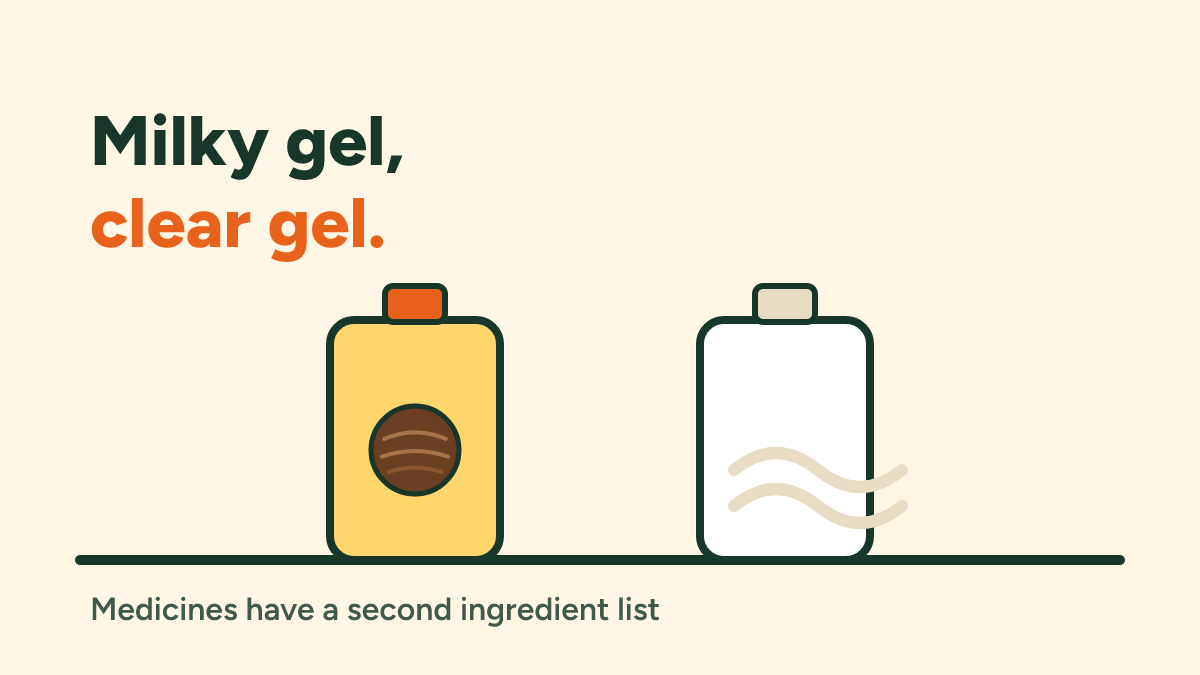
Milky gel, clear gel
Checking dozens of diclofenac products, a pattern shows up that's useful far beyond one brand:
- Milky "emulgel" or "emulsión gel" — an oil-and-water emulsion. Something has to hold those together, and that something is often a coconut-derived ester: cocoyl caprylocaprate, caprylic/capric triglyceride, or a dicaprylate/dicaprate.
- Clear alcohol gel — carbomer, alcohol, water, sometimes menthol. No oil phase, so nothing needs emulsifying.
Rule of thumb: milky pain gel, suspect it. Clear pain gel, more likely clean. The leaflet decides.
This isn't specific to diclofenac. Any cream or gel you rub in has the same architecture question behind it.
What to ask at the pharmacy
In English: "Could you read me the excipients? I'm allergic to coconut and I'm avoiding caprylic esters and anything starting with coco-."
In Spanish: "¿Me puede leer los excipientes? Tengo alergia al coco y evito los ésteres caprílicos y todo lo que empiece por coco-."
Pharmacists have the full product information on screen. It takes them thirty seconds.
Where else it hides in medicines
- Capsule shells and tablet coatings — medium-chain triglycerides (MCT) and other fatty esters are common carriers, especially in soft gel capsules.
- Syrups and drops — polysorbate 20 helps oils mix into water. (Polysorbate 80 is a different one, made from olive-type fatty acids.)
- Creams and ointments — cetearyl alcohol, glyceryl stearate, caprylic/capric triglyceride.
- Suppositories — hard fat, often coconut or palm kernel derived.
What's realistic
Most people with coconut allergy react to the protein, and heavily refined derivatives often cause nothing at all. Many people take medicines with these excipients for years with no trouble. Others react to something at trace level and don't know why.
What matters is being able to check, and being able to ask the right question. Not silently stopping a treatment.
Tell your allergist and your pharmacist about the allergy, and ask them to note it on your file. Then the check happens at the counter, before you get home.
Related
How to read a label · Coconut's many names · Where coconut hides
Sources
- Voltaren Emulgel (diclofenac diethylamine 11.6 mg/g), Summary of Product Characteristics. Rwanda FDA (PDF)
- Voltaren Emulgel, Product Monograph, Health Canada drug database. PDF
Educational only, not medical advice. Always confirm with your allergist.