Perfume, body mist, roll-on: which ones carry coconut
Alcohol perfumes are usually the safest kind. Oil roll-ons and solid perfumes are the riskiest, because their carrier is almost always coconut-derived. How to tell them apart in the shop.
Published September 25, 2026 · 3 min read
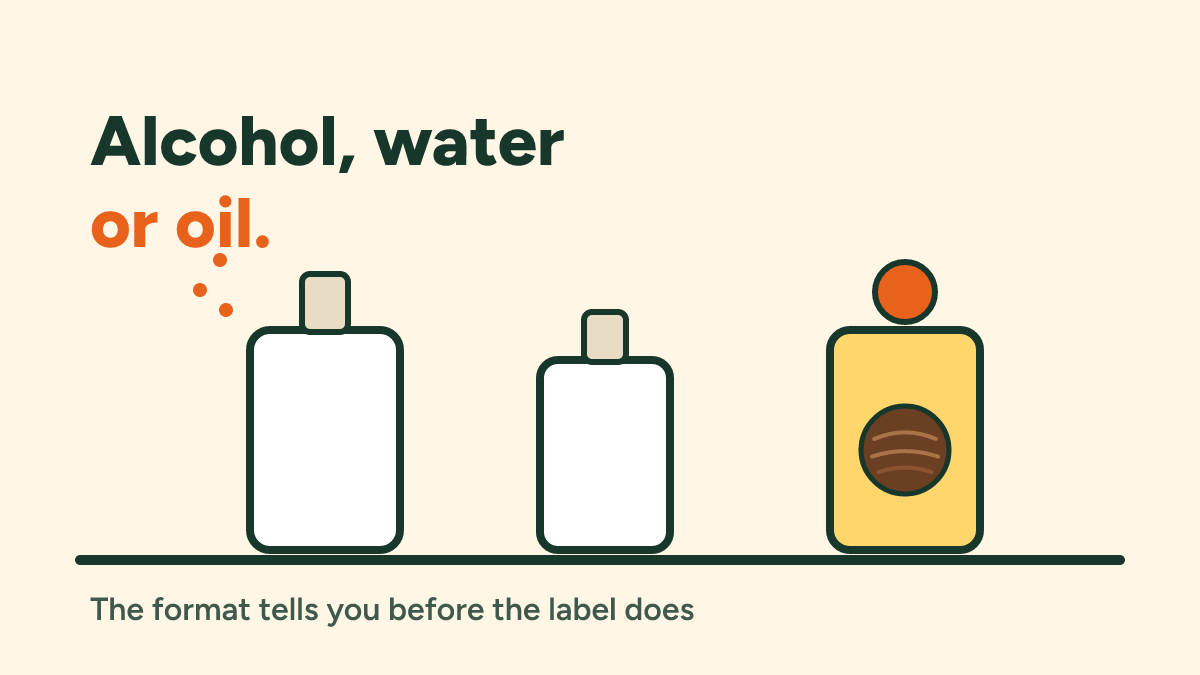
Fragrance is the one cosmetic category where people rarely check the label, because there's often no ingredient list on the bottle at all. Yet it goes on the neck and wrists, stays on all day, and is reapplied without thinking.
The good news: you can usually judge a fragrance by its type, before you even read the list.
The three-second test
Does the bottle say flammable? Then it's alcohol-based, and alcohol perfumes are the kind least likely to carry coconut.
Three kinds of fragrance, three different risks
1. Alcohol perfumes and mists — usually clean
Eau de parfum, eau de toilette and most body mists start with alcohol denat. Alcohol dissolves the perfume oils by itself, so the formula needs no fatty carrier and no emulsifier.
A body mist we checked lists alcohol denat., water, parfum, propylene glycol, glycerin, PPG-26-buteth-26 and PEG-40 hydrogenated castor oil. That last one is the solubiliser, and it comes from castor beans, not coconut.
2. Water-based mists and splashes — check the solubiliser
If the list starts with water, something has to make the perfume oils mix in. That something is worth reading:
- Polysorbate 20 — made from lauric acid, usually coconut or palm kernel. (Polysorbate 80 is a different one, olive-type.)
- Coco-caprylate, caprylyl/capryl glucoside — coconut-derived.
- PEG-40 hydrogenated castor oil — castor, not coconut.
3. Oil roll-ons, solid perfumes, "clean" fragrance oils — the risky ones
Here the perfume is carried in an oil, and the default carrier across the industry is caprylic/capric triglyceride, the refined coconut fraction also sold as MCT oil. Coco-caprylate is the other common one.
The irony is that the brands marketing themselves as gentle, natural and alcohol-free are the ones most likely to use it. "Alcohol-free perfume oil" almost always means "coconut-derived carrier".
The texture rule
This holds well beyond perfume, and it's worth carrying into every aisle:
Texture predicts how much, not whether. A creamy or oily product suggests a fatty base, and if that base is coconut-derived it's present at percentage level. A watery product has a clean base, but can still carry a coconut-derived helper further down the list.
So: creamy means check the top of the list. Watery means check the bottom.
When there's no list on the bottle
Perfume boxes carry the ingredient list more often than the bottles do. If the box is gone:
- Look up the product on the brand's own site, which usually publishes the full list.
- In the EU, a cosmetic must carry its ingredient list on the container or its packaging [1], so the information exists somewhere.
- If you can't find it, treat it as unknown. No published list means no verdict.
And the word "parfum" itself
Both the EU and the US let a whole mixture of scent ingredients appear as the single word parfum or fragrance [1, 2]. Coconut-derived materials can sit inside that word without being named.
For most people with coconut allergy, that matters less than it sounds: the reaction is usually to coconut protein, and fragrance materials are heavily processed. But if a product with "parfum" is one you use daily, it's a fair question to put to the brand. We ask brands exactly these questions.
Related
Coconut's many names · How to read a label · Coconut in medicines
Sources
- Regulation (EC) No 1223/2009 on cosmetic products, Article 19. EUR-Lex
- US FDA. "Fragrances in Cosmetics." fda.gov
Educational only, not medical advice. Always confirm with your allergist.